Monday, October 16, 2017

Almost All Numbers Contain the Digit Three

My mind was blown today when I came across the assertion (and proof!) that almost all numbers contain the digit '3'.

For small numbers of a given length of digits, you can count the ones that contain the digit '3'. You can see these values in the following table:

Number of digits Examples % Containing 3
1 (0-9) 3 10% (1)
2 (0-99) 3,13,23,30,31,32,33,34,35,36,37,38,39,43,53,... 19% (19)
3 (0-999) 3,13,...,30-39,...,300-399,430-439,... 27% (271)

You can count them by hand, but the count 'C' for any given number of digits 'n' is given by the following formula:

C = 10^n - 9^n

Thus the percentage is given by:

% = (10^n - 9^n) / 10^n
% = (10^n / 10^n) - (9^n / 10^n)
% = 1 - (9/10)^n

Taking the limit of this a n -> inf and you see that % = 1.

James Grimes does an excellent job of explaining it in this video:
https://www.youtube.com/watch?v=UfEiJJGv4CE

Monday, July 10, 2017

Palindrome Dates

If you follow the traditional American format of mm/dd/yyyy for dates, then today, 7/10/2017 is "palindromic". The next date to follow this format will be 8/10/2018. Coincidentally, it also works for the mm/dd/yy format -- 7/10/17. If you follow the European format of dd/mm/yyyy, you're going to have to wait until October 7, 2017 -- which, you guessed it -- also comes out as 7/10/2017. PS. Yes, I know I've played fast and loose with leading zeroes.

Thursday, July 6, 2017

Climb To Prime

John H. Conway’s proposed a list of math problems for which he is offering $1000 for a solution.   One of those is his “Climb to a Prime” conjecture, which is stated as:

Problem 5. Climb to a Prime:

Let n be a positive integer. Write the prime factorization in the usual way, e.g. 60 = 22 · 3 · 5, in which the primes are written in increasing order, and exponents of 1 are omitted. Then bring exponents down to the line and omit all multiplication signs, obtaining a number f(n). Now repeat.

So, for example, f(60) = f(22 · 3 · 5) = 2235. Next, because 2235 = 3 · 5 · 149, it maps, under f, to 35149, and since 35149 is prime, it maps to itself. Thus 60 → 2235 → 35149 → 35149 → ..., so we have climbed to a prime, and we stop there forever. The conjecture, in which I seem to be the only believer, is that every number eventually climbs to a prime. The number 20 has not been verified to do so. Observe that 20 → 225 → 3252 → 223271 → ... , eventually getting to more than one hundred digits without yet reaching a prime!

James Davis took up the challenge and found a counterexample: 13532385396179 = 13 ⋅ 532 ⋅ 3853
This prime number fails the conjecture because its factorization maps back to itself!

You can read a few more details here:

http://www.popularmechanics.com/science/math/news/a26815/why-13532385396179-is-a-magic-number/

Wednesday, July 5, 2017

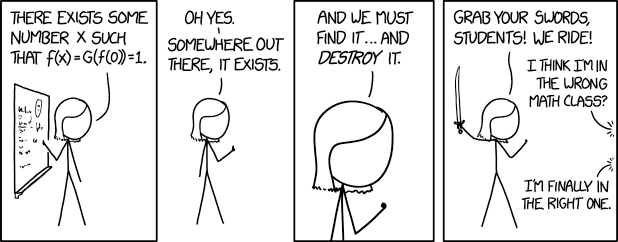
Finding the Right Math Class

An XKCD strip my kids could all relate to, from the author of "What if..." which they also loved:

https://xkcd.com/1856/

Monday, November 21, 2016

One Step Closer to Solving Sierpinski Prime Problem

The Sierpinski prime problem has been around for about 50 years.  The lowest known Sierpinski number is 78,557 and the quest is on to find the smallest.  After decades of effort, it had been narrowed down to six possible candidates: 10223, 21181, 22699, 24737, 55459 and 67607.

It's one of those "pure math" problems that sounds tantalizing simple to calculate, but requires immense computational effort.

After the announcement last month of the 7th largest known prime number, you can now strike 10223 off the list.

https://www.newscientist.com/article/2113283-crowdsourced-prime-number-could-help-solve-a-50-year-old-problem/


Monday, October 31, 2016

Pumpkin Pi

Today, I came across one of our old Halloween pics from a couple years ago (2014 I think) that I thought I would share:

Each year, the kids typically get to design (and help carve) their own pumpkins, and I sometimes get to do one for myself.   This was my contribution for that year.   It was inspired by this old "Foxtrot" comic by Bill Amend:

Jealous much?