If you follow the traditional American format of mm/dd/yyyy for dates, then today, 7/10/2017 is "palindromic". The next date to follow this format will be 8/10/2018. Coincidentally, it also works for the mm/dd/yy format -- 7/10/17. If you follow the European format of dd/mm/yyyy, you're going to have to wait until October 7, 2017 -- which, you guessed it -- also comes out as 7/10/2017. PS. Yes, I know I've played fast and loose with leading zeroes.
Monday, July 10, 2017

Thursday, July 6, 2017
Climb To Prime
John H. Conway’s proposed a list of math problems for which he is offering $1000 for a solution. One of those is his “Climb to a Prime” conjecture, which is stated as:
James Davis took up the challenge and found a counterexample: 13532385396179 = 13 ⋅ 532 ⋅ 3853
This prime number fails the conjecture because its factorization maps back to itself!
You can read a few more details here:
http://www.popularmechanics.com/science/math/news/a26815/why-13532385396179-is-a-magic-number/
Problem 5. Climb to a Prime:
Let n be a positive integer. Write the prime factorization in the usual way, e.g. 60 = 22 · 3 · 5, in which the primes are written in increasing order, and exponents of 1 are omitted. Then bring exponents down to the line and omit all multiplication signs, obtaining a number f(n). Now repeat.
So, for example, f(60) = f(22 · 3 · 5) = 2235. Next, because 2235 = 3 · 5 · 149, it maps, under f, to 35149, and since 35149 is prime, it maps to itself. Thus 60 → 2235 → 35149 → 35149 → ..., so we have climbed to a prime, and we stop there forever. The conjecture, in which I seem to be the only believer, is that every number eventually climbs to a prime. The number 20 has not been verified to do so. Observe that 20 → 225 → 3252 → 223271 → ... , eventually getting to more than one hundred digits without yet reaching a prime!
James Davis took up the challenge and found a counterexample: 13532385396179 = 13 ⋅ 532 ⋅ 3853
This prime number fails the conjecture because its factorization maps back to itself!
You can read a few more details here:
http://www.popularmechanics.com/science/math/news/a26815/why-13532385396179-is-a-magic-number/
Wednesday, July 5, 2017
Finding the Right Math Class
An XKCD strip my kids could all relate to, from the author of "What if..." which they also loved:
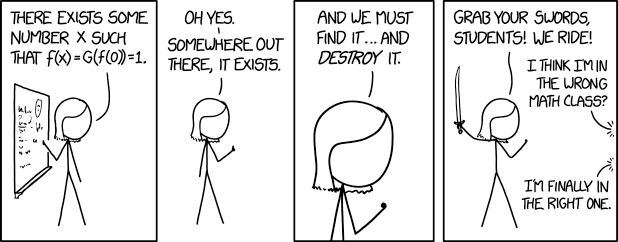 |
| https://xkcd.com/1856/ |
Sunday, December 25, 2016

Monday, November 21, 2016
One Step Closer to Solving Sierpinski Prime Problem
The Sierpinski prime problem has been around for about 50 years. The lowest known Sierpinski number is 78,557 and the quest is on to find the smallest. After decades of effort, it had been narrowed down to six possible candidates: 10223, 21181, 22699, 24737, 55459 and 67607.
It's one of those "pure math" problems that sounds tantalizing simple to calculate, but requires immense computational effort.
After the announcement last month of the 7th largest known prime number, you can now strike 10223 off the list.
https://www.newscientist.com/article/2113283-crowdsourced-prime-number-could-help-solve-a-50-year-old-problem/
Monday, October 31, 2016
Pumpkin Pi
Today, I came across one of our old Halloween pics from a couple years ago (2014 I think) that I thought I would share:
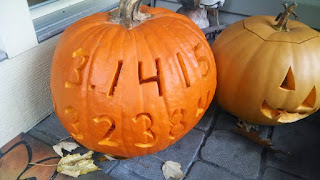
Each year, the kids typically get to design (and help carve) their own pumpkins, and I sometimes get to do one for myself. This was my contribution for that year. It was inspired by this old "Foxtrot" comic by Bill Amend:

Jealous much?

Each year, the kids typically get to design (and help carve) their own pumpkins, and I sometimes get to do one for myself. This was my contribution for that year. It was inspired by this old "Foxtrot" comic by Bill Amend:

Jealous much?
Monday, October 10, 2016
Prime Number Distributions
Here's an interesting article that was a hot topic around the dinner table:
https://www.newscientist.com/article/2080613-mathematicians-shocked-to-find-pattern-in-random-prime-numbers/
Prime numbers (other than 2 and 5) must end in a 1,3,7 or 9. Over the first few hundred million prime numbers, researchers found that a prime ending in 1 is followed by another prime ending in 1 just 18.5 per cent of the time instead of a more or equal distribution of 25 per cent.
Subscribe to:
Posts (Atom)